











 5
5
A CRM system is often perceived as a database of contacts and transactions, but with the right approach, artificial intelligence can transform it into a fully-fledged business assistant that analyzes data in real time, predicts customer behavior, automates routine tasks, and frees up managers for other work.
Companies that have already integrated AI into their CRMs are seeing increased conversion rates, shorter sales cycles, and reduced workload on their teams.
Below are ten features, along with an explanation of how each one works and the real-world benefits it provides to businesses.
1. AI agent for generating responses in CRM chat
An "AI Response" button is integrated into the CRM interface. When a message arrives from a client — via Telegram, WhatsApp, the website, or email—the manager clicks the button and instantly receives a pre-prepared response. The AI analyzes the entire conversation history, client data, information about the company's services, and the tone of the conversation. The pre-prepared text is entered into the input field. The manager decides whether to send it as is, edit it, or request a different version. The message is sent only after it is confirmed — human control remains.
Managers spend most of their time choosing words rather than making decisions. The same scenario — answering a price question, clarifying application details, explaining terms— is repeated dozens of times a day. AI takes care of the grunt work: it generates relevant text tailored to the context, company style, and specific situation. Managers don't write from scratch; they review and confirm.
Real benefits:
- Managers spend several times less time on correspondence without losing the quality of communication or breaking away from the company's style.
2. AI bot for initial client qualification with brief transfer to CRM
When a potential client submits a request, a manager typically spends the first 30-60 minutes understanding exactly what's needed, the scope of the task, and the requirements. An AI agent takes care of this. The client is sent a link to a Telegram bot, which asks clarifying questions, processes the answers, and generates a structured brief. The completed brief is automatically sent to the CRM: the manager opens the new lead's profile and sees the already collected project information, not just a vague "I want a website" statement.
This changes the quality of the initial contact for both parties. The client is qualified at a comfortable pace and without feeling interrogated. The manager begins the conversation prepared – with an understanding of the task, budget, and expectations. The first call becomes meaningful, not introductory.
Real benefits:
- This is especially valuable when there is a high flow of incoming requests—the bot processes them in parallel, without queues or team involvement.
- Managers are connected already at the qualified lead stage.
3. Automatic call quality analysis
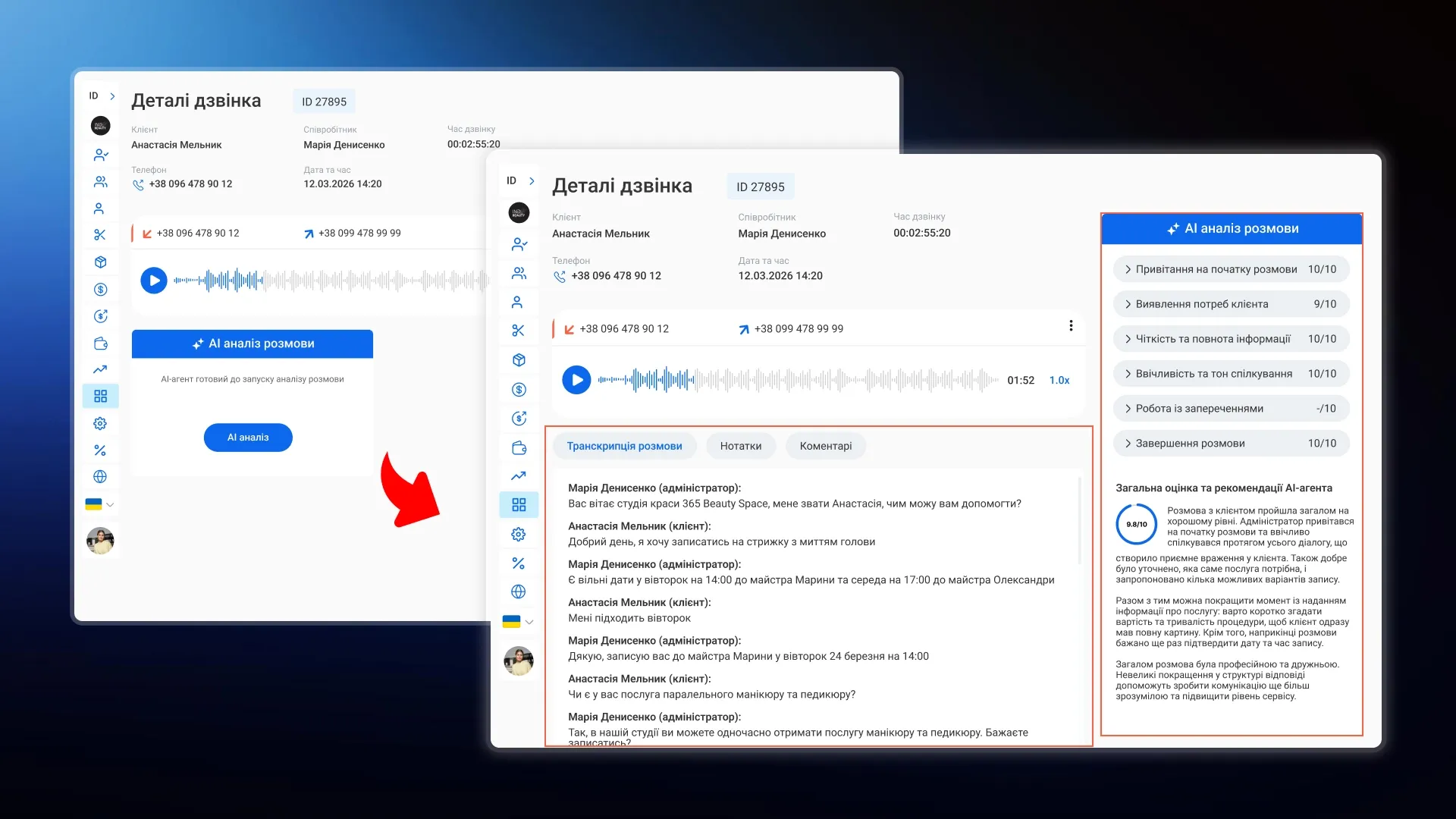
Call recordings accumulate in the system, but there's neither the time nor the resources to manually review them. AI solves this problem without human intervention: after the call ends, the agent automatically transcribes the recording, evaluates the quality of the consultation based on specified parameters — whether the manager identified the need, handled objections correctly, and suggested the next step — and generates a structured report with recommendations. All of this appears in the call card within the CRM with a single click.
The manager sees not just isolated recordings, but a systemic picture across the entire team: who consistently makes strong calls, who is struggling at a specific stage of the conversation, and where clients are being lost. This changes the approach to training — instead of general training, we focus on addressing the real mistakes of individual employees.
Real benefits:
- A new manager reaches the required level more quickly - he has before him not abstract instructions, but an analysis of his own calls with specific comments.
- The manager does not spend hours listening - he only looks at the final assessments and intervenes where necessary.
4. Automatic call summaries and card filling
After a call or meeting, the AI transcribes the recording, highlights key points — what was agreed upon, any objections, what the manager promised, and what the next step should be — and automatically populates the relevant fields in the deal card. The summary appears in the CRM within minutes of the call, without any manager intervention.
On average, a manager spends 30-45 minutes a day filling out the CRM after calls. This time is wasted – no value for the client, no progress on the deal. AI solves this problem completely: data is entered into the system accurately and quickly, and the manager immediately moves on to the next contact.
Real benefits:
- When a client is transferred to a new manager or replaced during vacation, the colleague opens the card and sees the full context of the latest negotiations, and the client does not feel a disconnect.
- The manager can check at any time what exactly was promised to the client during each call and ensure that agreements are being fulfilled.

5. Voice control CRM
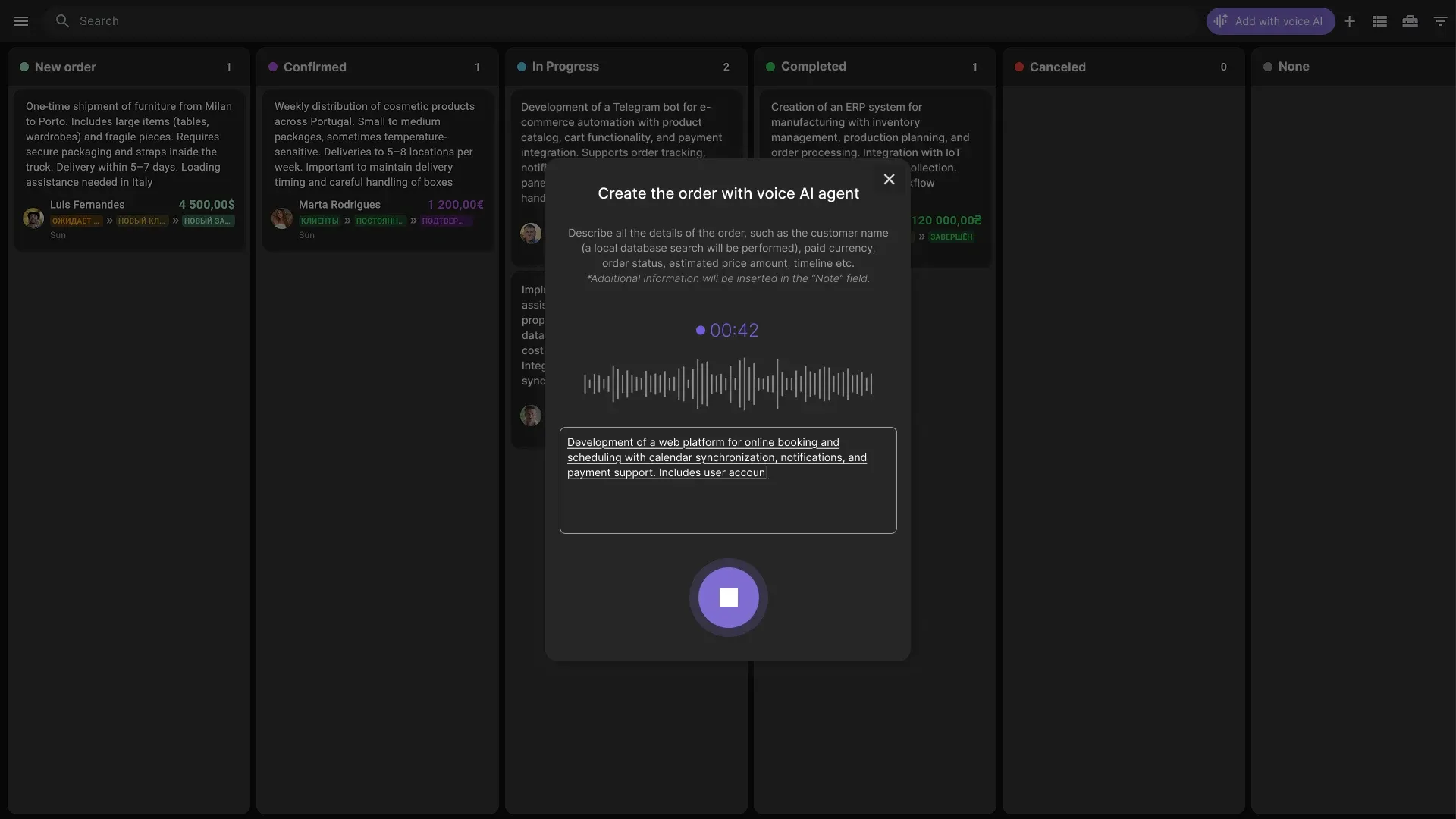
The manager works in a constant state of transition: call, CRM entry, next call. The AI voice agent eliminates the main source of time loss — manual data entry. The manager speaks aloud — the system recognizes the speech, processes it and performs the desired action: recording a transaction comment, creating a note, generating a response to the client, or filling out a field in a card. All this without switching to the keyboard or losing your train of thought after the conversation.
This is especially critical during a call or immediately after: the details are fresh, but your hands are busy or there's no time to enter them. Voice input allows you to capture information as it's available, rather than having to recall it from memory an hour later.
Real benefits:
- Managers who handle 30-50 calls per day reduce the time spent on administrative tasks in CRM several times over.
- Data enters the system more accurately—not because the manager has become more attentive, but because the barrier to entering information has become minimal.

6. Lead scoring during the communication process
As a client interacts with a manager — writing in chat, answering questions, sending a brief— the CRM accumulates information about them. AI analyzes this data in real time and automatically assigns a lead score: how close they are to making a decision, how specific the request is, and whether there are any signs of readiness to move forward. The score is updated as the conversation progresses—the more data, the more accurate the picture.
This helps managers and supervisors see the real state of each lead without manual analysis. It's clear who needs more attention right now, and who is still in the early stages. Priorities are set based on data, not feelings.
Real benefits:
- With a large influx of incoming leads, scoring helps the team focus efforts where the likelihood of closing is highest.
- The manager sees not just a list of contacts in the queue, but understands with whom a conversation is already ripe, and with whom time needs to be given.

7. Next Best Action
The AI analyzes the current deal stage, client activity, time since the last contact, and the behavior of similar deals in the past. Based on this, the system generates a specific recommendation directly in the deal card: call today, send a commercial proposal, give until Friday, or escalate. No general advice — only specific actions tailored to the specific situation.
A manager with a large portfolio of deals can't keep track of what needs to be done for each one and when. As a result, some deals get stuck — not because the client isn't interested, but because the manager simply doesn't have the time. Next Best Action solves this problem without reminders or task managers.
Real benefits:
- This is especially valuable for new employees — the system guides them through the optimal scenario, and the newcomer works effectively from the first month.
- For experienced managers, this is insurance against deals falling out of focus during high workloads.

8. AI agent for preparing commercial proposals
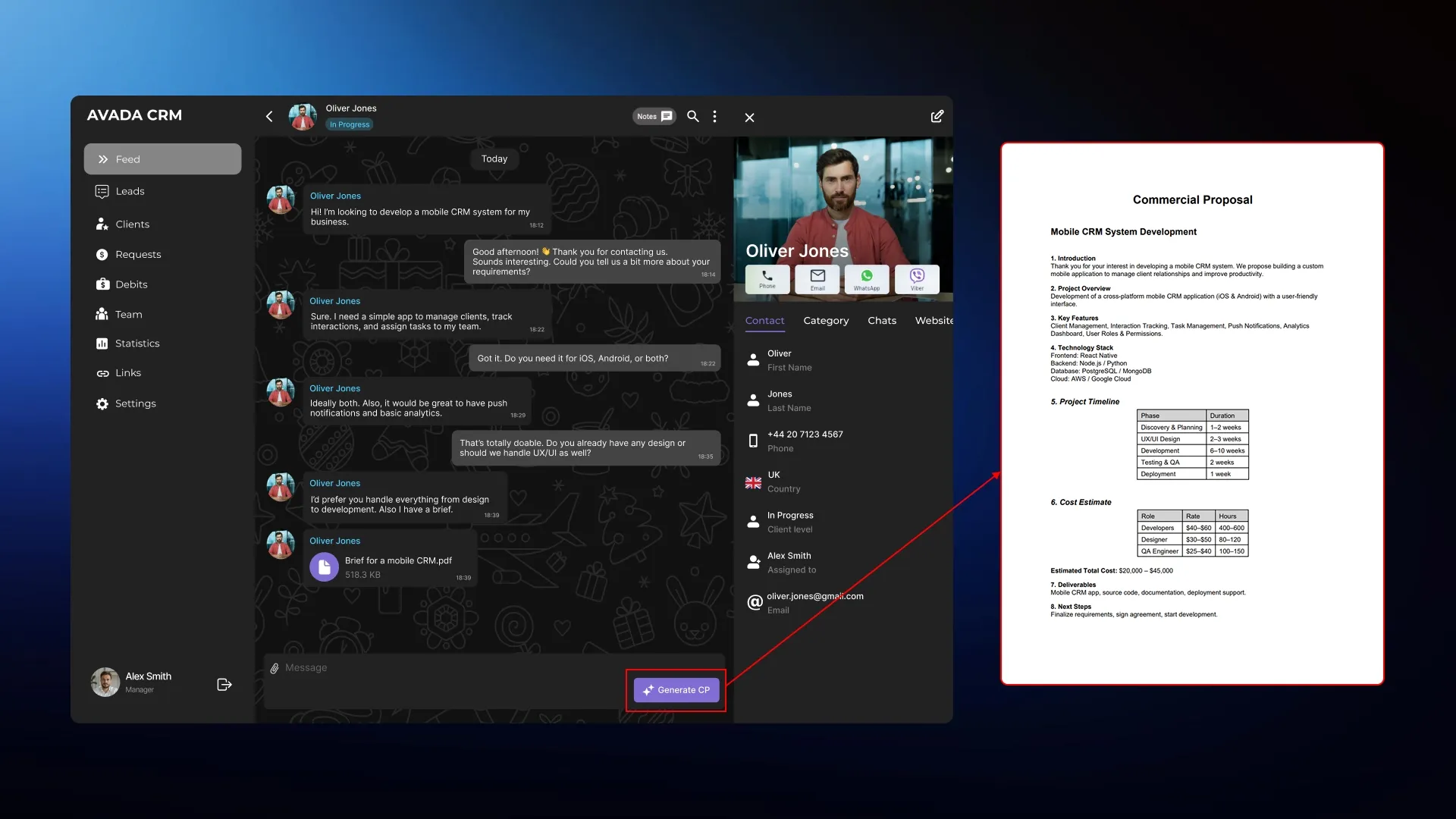
Developing a commercial proposal is one of the most labor-intensive tasks in sales. A manager must review the brief, gather data from multiple sources, select suitable solutions, structure the proposal, calculate the timeline and budget, and finalize the document. A single proposal takes between one and four hours. An AI agent within the CRM handles this automatically: it analyzes the client's request, correspondence, brief, and internal company data — price lists, knowledge base, past projects — and generates a completed commercial proposal within the company's established structure.
The manager receives a draft proposal directly in the CRM and, if necessary, adjusts it before sending. The final decision rests with the manager, but 80% of the work is already done.
Real benefits:
- The sales team sends commercial proposals several times faster, the quality of proposals becomes stable and does not depend on the experience of a specific manager.
- From the first week, a new employee prepares proposals at the level of an experienced colleague.
9. Intelligent request routing
The system analyzes the content of the incoming request, the client's history, and the team's current workload. Based on this, the request is automatically assigned to the manager who knows the client, specializes in the required product, or is simply available. Routing rules are customized to the specific team structure.
In companies without automatic routing, incoming requests either sit unassigned or are dumped on a single on-duty manager. Clients wait, the workload is unevenly distributed, and some requests are lost. AI creates the routing logic once, and then everything runs smoothly.
Real benefits:
- A client with whom a specific manager has already worked is automatically assigned to them—there's no need to explain the context from scratch.
- A technical request goes to the technical department, a commercial request goes to sales.
- The average time to first response is reduced by 2-3 times.

10. Personalized recommendations for upsells and cross-sells
Based on the customer's purchasing history, their industry, company size, and the behavior of similar customers, the AI determines which product or service to offer at the right time. The recommendation appears in the deal card or automatically triggers a task for the manager to contact them with a specific offer within a specific timeframe.
Managers often don't offer additional products — not because they don't want to, but because they don't know who needs them and when. AI eliminates this uncertainty: the system automatically determines the right moment and selects the offer most likely to interest the customer. The average order value increases without putting pressure on the manager or being intrusive to the customer.
Real benefits:
- The client purchased the basic package three months ago and is actively using it. AI recommends offering the extended version now.
- For customers in the manufacturing sector who buy product A, the system recommends offering product B - because 70% of similar customers buy them together.

How AI functions are integrated into CRM
All the functions described in this article can be implemented within a custom CRM system. This means that a system is designed from scratch to meet the needs of a specific business, with AI modules built into the system from the start — as a fully-fledged part of the architecture, not an add-on.
The feature set, operational logic, and integration with external services and internal systems are all defined at the design stage and tailored to the company's actual processes. Lead scoring, call analysis, voice control and response generation — each function works in conjunction with the others and with the business's existing data.
You can start with one or two priority functions and expand the system as your tasks grow.
Looking to implement AI features in your CRM? CortexIntellect develops intelligent solutions that integrate into existing processes and deliver measurable results from the first few weeks of operation.

