











 6
6
A website has long ceased to be just a business card; it should function as the first point of contact with a client: answering questions, building trust, and encouraging them to submit an application. But this is where many business owners run into a bottleneck. A potential client lands on the website, doesn't find a quick answer to their question, and leaves. Managers spend several hours a day on repetitive consultations and collecting basic information. Applications arrive with incomplete information, and too much time passes before a real conversation takes place.
Artificial intelligence is changing the logic of this work. It takes over routine but critically important tasks: initial communication, data collection, content generation, and user assistance at any time of day or night. Below are ten features that truly accelerate the customer journey from the first website visit to the final sale.
1. AI consultant and briefing generator
One of the most resource-intensive stages of working with a client is the initial consultation. The manager explains the same thing over and over, asks standard questions, and tries to distill a vague request into something concrete. An AI consultant performs this work automatically: asking clarifying questions, conducting a conversation based on the funnel logic, accessing the company's internal knowledge base, and ultimately creating a structured brief, which is then handed over to the manager, ready for action.
A practical example: the CortexIntellect team developed such an assistant for the AVADA group of companies. A single AI agent works across multiple websites simultaneously, using separate knowledge bases for each area. As a result, managers receive qualified leads with a ready-made project description, and the time from the first contact to task assessment is significantly reduced.

2. AI generator of product descriptions and ads
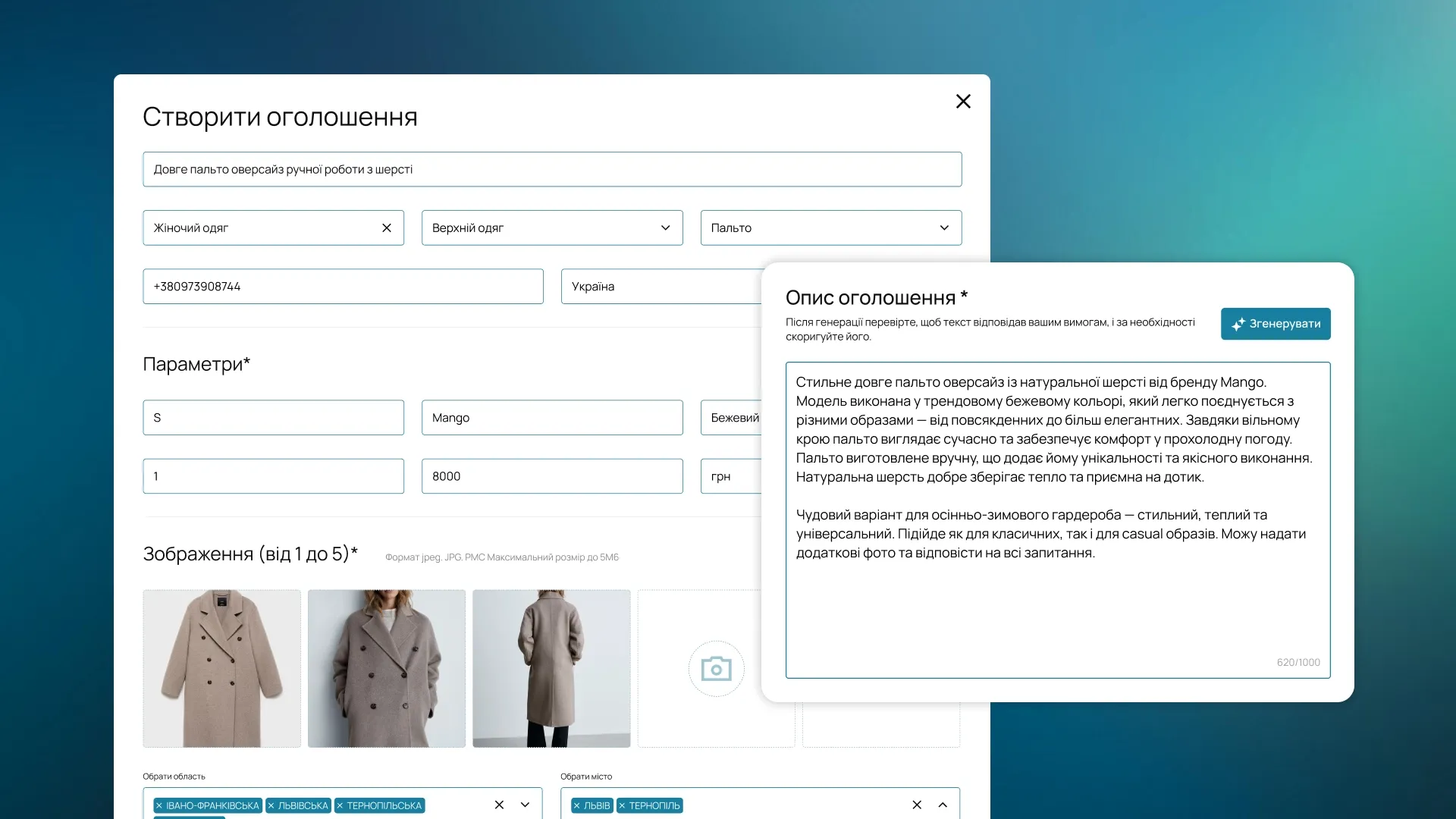
The quality of the text directly impacts conversion. Users who publish ads or product listings often write briefly, unstructured, and without emphasizing the benefits. An AI assistant analyzes basic data — the title, category, and features — and generates a compelling description with a clear structure and call to action. The user can accept the text, edit it, or request a new version.
CortexIntellect implemented this tool on the BTW.shopping platform. After the launch, ad quality improved, the number of posts increased, and the click-through rate increased. A detailed analysis of the solution is available in CortexIntellect's portfolio.
3. Smart site search with contextual understanding
Standard search searches for exact matches of words. Smart search understands the intent of the query: if a user types "I want to automate hiring," the system finds relevant pages about HR tools, even if the word "hiring" isn't mentioned. This search shortens the path to the desired information, keeps the user on the site, and increases the likelihood that they'll find exactly what they're looking for.
Practical result: sites with semantic search experience a decrease in bounce rate and an increase in pageview depth.
4. AI audio page assistant
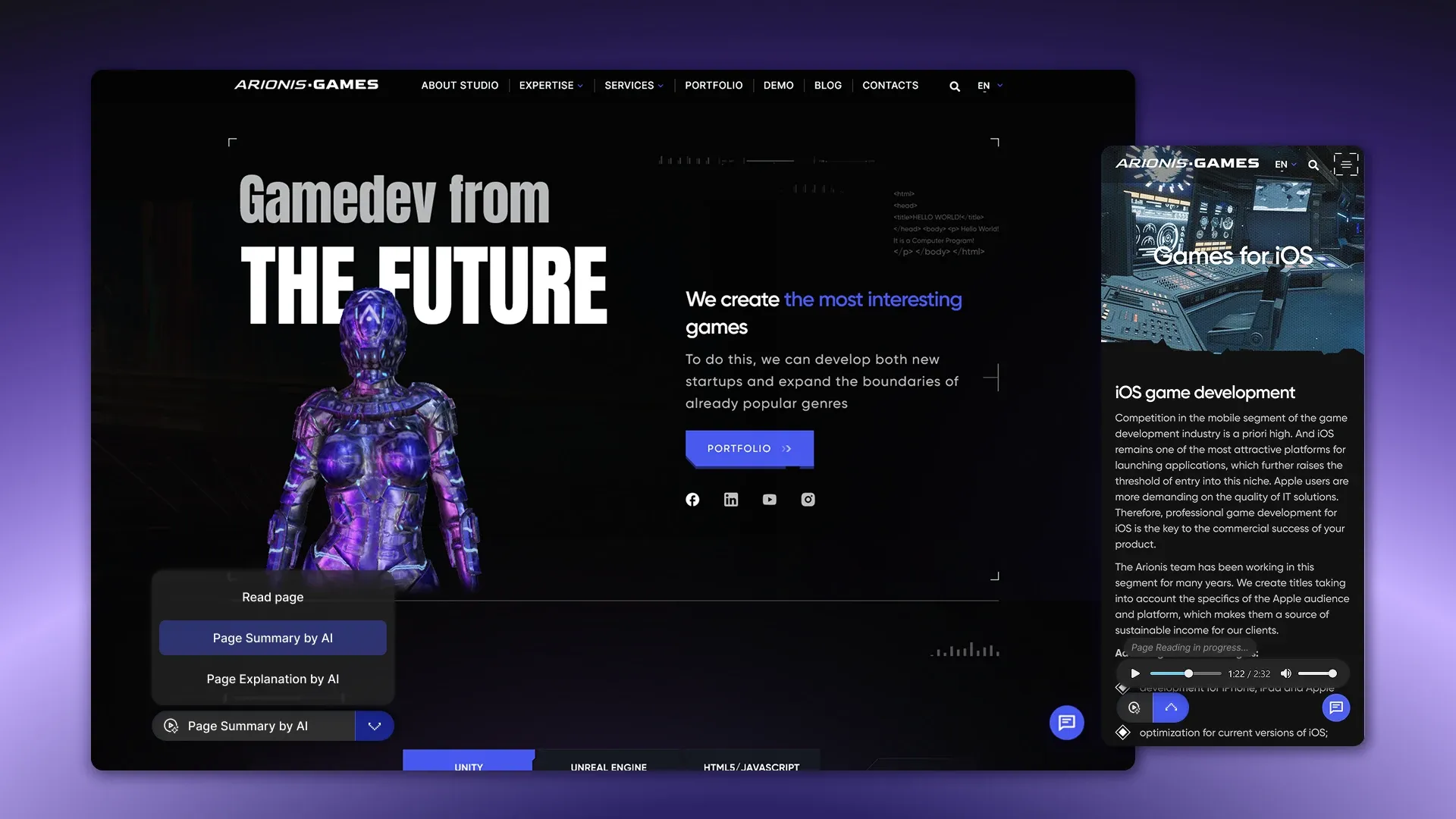
Most users don't read long texts — they scan the page and leave without getting to the point. An AI audio assistant solves this problem: it reads the page content aloud, generates a brief summary, or explains complex material in simple terms. Users choose the mode — full listening, overview, or explanation — and interact with the content in their preferred format.
CortexIntellect developed just such a module, a compact widget with a mini-player. The widget supports three scenarios, synchronizes the text transcript with the playback, and is easily embedded into any website. The result is increased user engagement and increased time on page.
5. Real-time AI-based content personalization
A website displays the same content to all visitors, regardless of whether they're a new user or a regular customer, a small business owner or a corporate buyer. AI personalization changes this: the system analyzes visitor behavior, traffic sources, and interaction history, and tailors content, offers, and recommendations to the specific user right at the moment of their visit.
Companies that have implemented personalization at the website level report an average increase in conversion rates of 15-30% compared to static content.

6. Automatic lead qualification
Not every lead who submits a request is ready to buy. The AI system analyzes user data — answers to questions, website behavior, and company characteristics — and assigns a score to each lead, measuring how well they match the target profile, what stage of the decision-making process they are at, and what their priority is for the manager. This allows the sales team to focus on hot leads and avoid wasting time on irrelevant inquiries.
The result of implementation: managers stop working according to the principle “all requests are equally important” and begin to move the funnel consciously.

7. AI chat with 24/7 support and transfer of dialogue to a manager
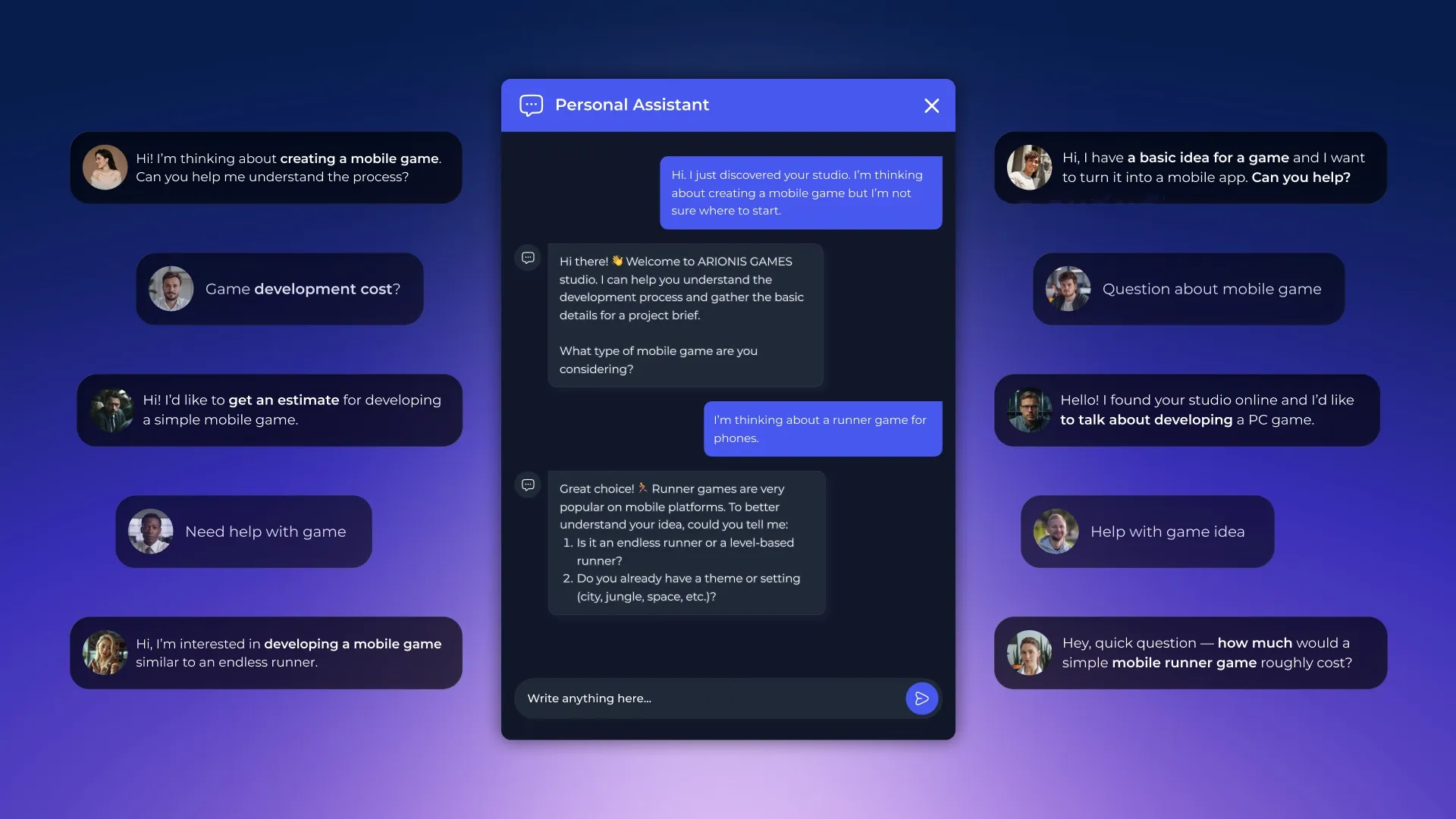
Clients don't just contact us during business hours. AI chat handles inquiries 24/7: it answers common questions, collects contact information, and clarifies the task. When a request requires live engagement, it transfers the conversation to a manager with the full context of the conversation, so the specialist doesn't start the conversation from scratch.
The key advantage of this solution is the speed of response. A customer who receives a response within a minute is much more likely to continue the conversation than one who waits several hours.
8. AI analysis of feedback and reviews
Customer reviews contain valuable information: what works, what annoys, and where questions arise. Manually analyzing a large stream of feedback is labor-intensive. An AI system automatically categorizes reviews by topic, identifies recurring patterns, determines sentiment, and generates a summary of key findings. Business owners receive not just a trove of text, but a structured picture of the customer experience.
This makes it possible to make decisions about improving a product or service based on real data, rather than intuition.

9. AI recommendation system for upselling and retention
The user explores a single service or product, while AI analyzes their behavior and suggests something that logically complements their request. This works for online stores, SaaS platforms, and service companies: the system recommends related services, relevant case studies, or materials that help the customer move further down the funnel independently.
A well-configured recommendation system increases the average order value and reduces churn — users see that the product understands their needs and stay longer.

10. Real-time AI translator
The language barrier is one of the most subtle yet tangible reasons for client loss. A user visits a website, writes in their native language, receives a delayed or incorrect response, and then leaves. The manager, in turn, wastes time translating or even passes the request on to a colleague.
The AI translator is integrated into the website's communication channel and works for both parties simultaneously: the client writes in Spanish, Portuguese, Arabic, or any other language, and the manager sees the text in their own language. The manager responds in Russian or Ukrainian, and the client reads it in their own language. Translation occurs in real time, without delay or switching between tabs.
The practical result: the company stops losing international clients due to language barriers, managers don't waste time on manual translation, and response times remain the same as when working with a local audience. For businesses that operate in multiple markets or receive traffic from different countries, this directly accelerates the sales cycle without increasing staff.

How to add AI features to your website
Each of the listed features is a standalone module that plugs into an existing website without affecting its core architecture. The website isn't rewritten or migrated to a new platform. The module is built on top of what's already there.
The basic integration scheme is the same for all functions: a user entry point—a widget, button, or form—appears on the website. A user action triggers a request sent to the backend, where it's processed by an AI model, and the result is returned back to the website interface, CRM, manager email, or multiple channels simultaneously. The visual component is integrated via a small snippet of code in the page body and adapts to the website design.
Most functions operate through language model APIs — OpenAI and similar models. This means that the primary computing load is carried by the provider, not the website's servers. Scaling occurs automatically: the same module operates equally reliably with 10 or 10,000 requests per day.
Functions that work with company data — consultant, commercial agent, semantic search— additionally require the creation of a knowledge base. Documents, price lists, website pages, and other materials are indexed and loaded into a vector database. This is where the AI gets context for its responses, rather than generating information out of thin air. The database is updated as company materials change.
The most effective scenario is when AI functions are built into the website architecture during the development stage, rather than added to an existing solution. Custom development allows for the proper data structure to be established from the start, AI modules to be connected, and the tradeoffs that inevitably arise when integrating into an existing website. As a result, functions run faster, are more deeply integrated into business processes, and are easier to scale as the company grows. A website designed with AI in mind from the start becomes a fully-fledged customer service tool, not a collection of modules tacked on top of a static platform.
The implementation time depends on the complexity of the feature and the infrastructure readiness. Simple modules based on a ready-made API are launched in one to two weeks. Solutions with a proprietary knowledge base, CRM integration, and custom dialog logic require three to six weeks, including configuration, testing, and training on company data.
Let's discuss your project
Whether you're looking to implement a specific feature or build a full-fledged AI infrastructure for customer service, the CortexIntellect team is ready to analyze your needs and offer a suitable solution. Submit a request on our website, and we'll discuss which features are relevant for your business, how to implement them, and where to start.

