











AI agent Telegram-bot to automate primary communication with customers
Every day, companies receive dozens or hundreds of requests from potential customers: website inquiries, instant messenger notifications, short clarifications before starting cooperation. It is at this stage that the first impression of your business is formed and operational overload often occurs: slow responses, lost leads, manual processing of the same type of questions.
To automate initial communication without losing the quality of the dialogue, we developed an AI agent — an intelligent digital assistant that takes on the first contact with the consumer. We tell you more about the implementation of the solution: from architecture to the business effect of implementation.




The essence of the project
CortexIntellect has developed an AI agent to automate the initial qualification of clients for a web development company. The agent works as a Telegram bot.
The agent's main task is to automatically analyze the client's request and create a structured brief for the manager.
How does an AI agent work:
- understands the content of the appeal;
- asks clarifying questions;
- studies the answers;
- uses the company's internal knowledge base;
- generates a project description with query parameters.
As a result, managers immediately receive systematized information and work with high-quality leads.
Initial problem
Before implementing the solution, managers spent a significant amount of time on initial communication with clients: clarifying the request, collecting basic data, preparing a brief. Most applications came in incomplete - with vague wording, without clear requirements and technical details.
Managers had to manually sort through information through a series of clarifying questions. This increased the duration of the first contact, slowed down the sales process and created an uneven load on the team. In addition, managers could not always instantly use the full volume of corporate knowledge during a dialogue with the client. As a result, the quality of the preliminary check depended on the human factor, and some potential leads were lost at the initial stage of interaction.
Proposed solution
The CortexIntellect team has developed an AI agent that automatically performs initial customer qualification.
The AI agent conducts a dialogue with the client, analyzes the content of the request and determines its essence. During the communication, it asks questions for specification, collects requirements for the project and fixes the main parameters. During the analysis, the agent uses the company's internal expertise, which allows taking into account the specifics of the services and technical features of the development.
Based on the information received, the system generates a brief description of the project, ready for processing. The generated document is transferred to the manager, who receives complete and organized information for the next stage of communication.


Where is an AI agent used?
The agent functions like a bot in Telegram. Users can send a request, get answers to standard questions, and go through initial qualification in automatic mode. The system builds a logical conversation, asks for details, and gradually collects the necessary information to create a report.
Basic functionality of an AI agent
The AI agent performs the full cycle of initial qualification of applications - from understanding the client's intention to compiling a report for the team.
Parsing a customer request
The system interprets the content of the notification and determines the parameters of the request. Artificial intelligence establishes the client's goal, approximate project type, and standard requirements, even if the request is described vaguely or fragmentarily.
Automatic brief creation
Based on the dialogue, the AI agent generates an ordered document that contains:
- general description of the project;
- formulated user requirements;
- expected goals;
- source data for future work.
Dialogue qualification
Artificial intelligence independently asks questions to fill in gaps in information. The conversation logic adapts to the client's answers.
Multilingual support
The AI agent recognizes requests in different languages and processes them correctly. Therefore, the user can write in a language convenient for him without switching the interface or losing the quality of understanding.


Integration with internal knowledge base
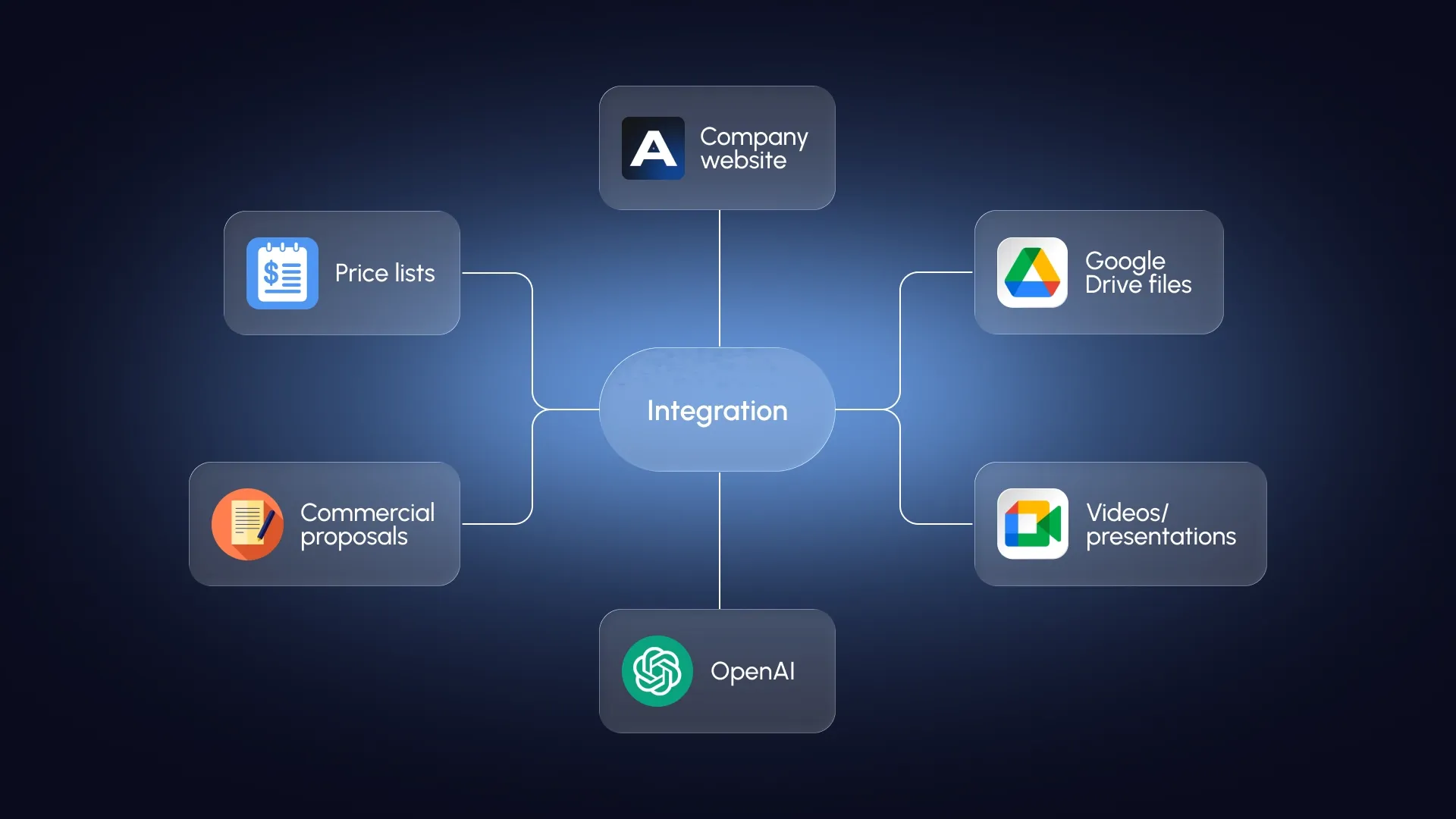
An important component of the solution is the connection of the AI agent to AVADA MEDIA's internal information sources. The system works not only with user dialogue, but also with accumulated business expertise.
The agent has access to:
- pages of the company's official website;
- previously prepared commercial offers;
- current price lists;
- work files in Google Drive;
- various video materials/presentations.
Thanks to this, AI correctly interprets the company's services, takes into account real approaches to project evaluation, and relies on actual data, rather than general formulations.
Agent interaction scenario
Step 1. Initiate the request
The client sends a message via the Telegram bot. It can be a short request or a preliminary description of the task.
Step 2. Initial message parsing
The agent studies the content of the application, identifies the main purpose of the client's request and basic parameters.
Step 3. Questions for clarification
AI creates a list of additional questions to clarify details: functional requirements, scope of work, deadlines, technical features.
Step 4. Getting customer responses
The user responds in a convenient format, and the agent records and systematizes the information received.
Step 5. Using internal knowledge
The digital assistant correlates dialogue data with materials from the internal database: services, typical solutions, preliminary calculations, and the company's achievements.
Step 6. Forming a structured brief
Based on the collected information, the AI solution generates a logically organized document with a description of the task, requirements, goals, and input data.
Step 7. Transfer to the manager
The finished report is transferred to the responsible manager for future processing.
Step 8. Continuing communication
The manager joins the process with a full understanding of the client's needs, proceeds to discuss the details of cooperation and estimate the cost.

Technology stack
We developed the solution as a holistic system with consistent logic for processing requests and integration with the company's internal resources.
- AI agent architecture → the server side is implemented in Python, and process automation is via n8n.
- Natural language analysis → understanding customer messages and highlighting key intentions based on OpenAI models.
- Knowledge base search → access to the company's internal expertise through the Qdrant vector database using the RAG approach.
- Cloud processing → performing calculations on remote servers to guarantee continuity.
- Telegram Bot API → interaction with customers through a bot in the messenger using the Telegram API.
Business value
- Reducing the burden on managers – the system takes care of the initial communication and collection of basic data.
- Determining the quality of a lead – the availability of input data and the relevance of the request are immediately determined.
- Automation of starting qualification – all applications undergo a single evaluation algorithm.
- Acceleration of lead processing – the time from first contact to the manager starting work is reduced.
- Improving the quality of technical tasks – the manager receives a systematized and complete description of the task.
- Conversion growth – the share of requests that turn into real projects increases.
- Standardization of communication – the process of interaction with users is unified regardless of the contact channel.
Implementation results
The implementation of an AI agent has made it possible to automate the initial qualification of customers and translate it into a systematic, managed process. This significantly shortens the sales cycle, reduces the operational burden on the team, and increases the efficiency of managers. As a result, the business receives a more predictable process of processing requests and higher efficiency of conversion into projects.

