











 512
512
Today, many companies are already using ChatGPT and other AI tools to prepare messages, respond to clients, and generate texts. But in most cases, artificial intelligence operates blindly it knows nothing about your company, your services, case studies, prices, presentations, or internal documents.
Because of this, responses are often too general, and managers still have to manually search for links, commercial proposals, work samples, and marketing materials. This is especially problematic for companies with large amounts of corporate data: websites, PDF presentations, price lists, CRM systems, case studies, videos, briefs, instructions, and internal documents.
This is where the next level of artificial intelligence comes in: AI agents with a corporate knowledge base.

How does such an AI agent work?
The technology's essence is that a company's internal information is collected into a single knowledge base, then indexed and prepared for the AI model. The following sources can be used:
- company websites;
- commercial proposals;
- PDF presentations;
- price lists;
- CRM system;
- portfolio;
- Google Docs and Sheets;
- videos and transcriptions;
- internal instructions;
- correspondence and response templates;
- catalogs of goods and services.
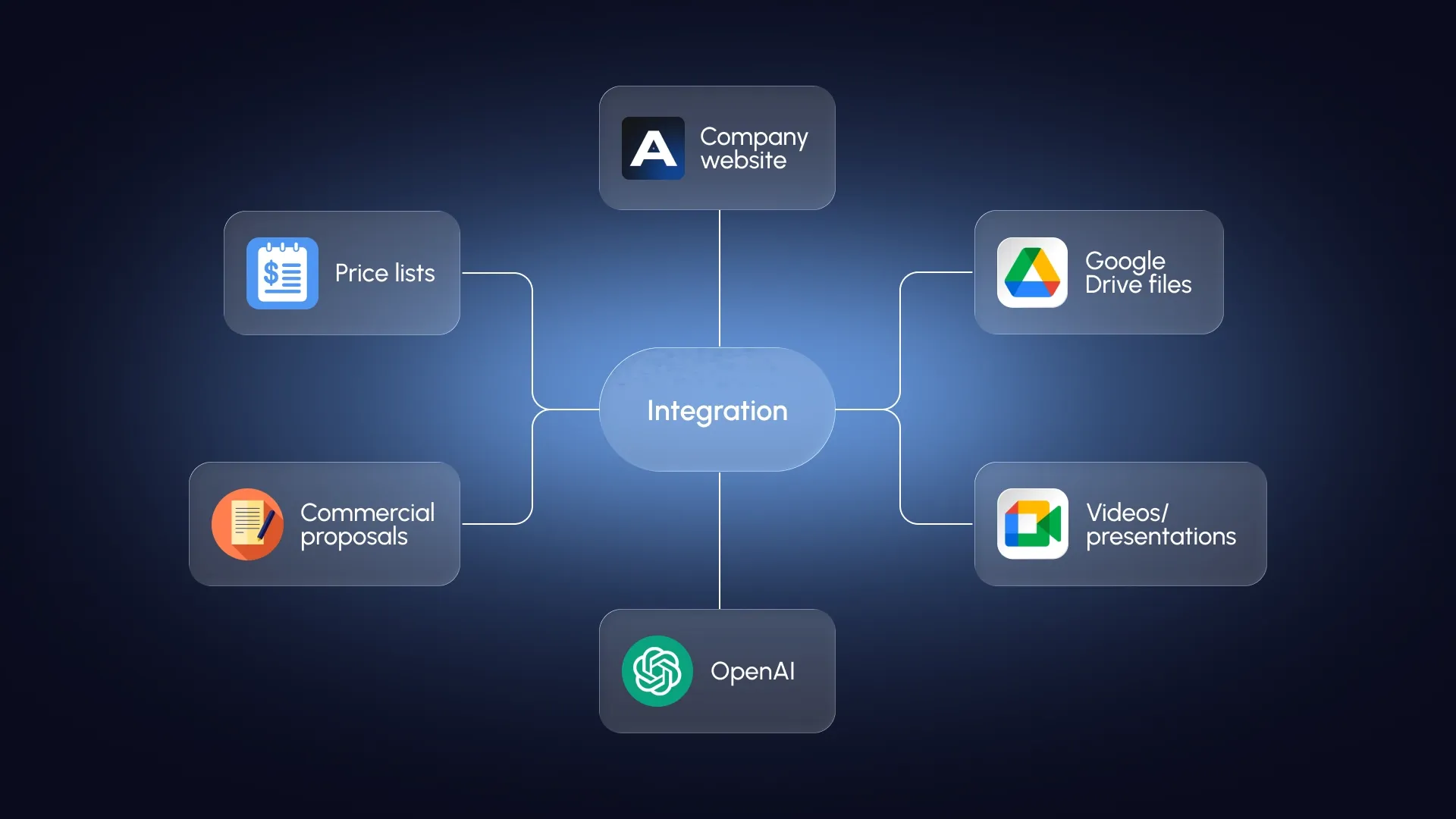
After processing this information, the AI agent is able to not only generate text, but also use real company data when preparing responses to clients.
For example, the manager writes:
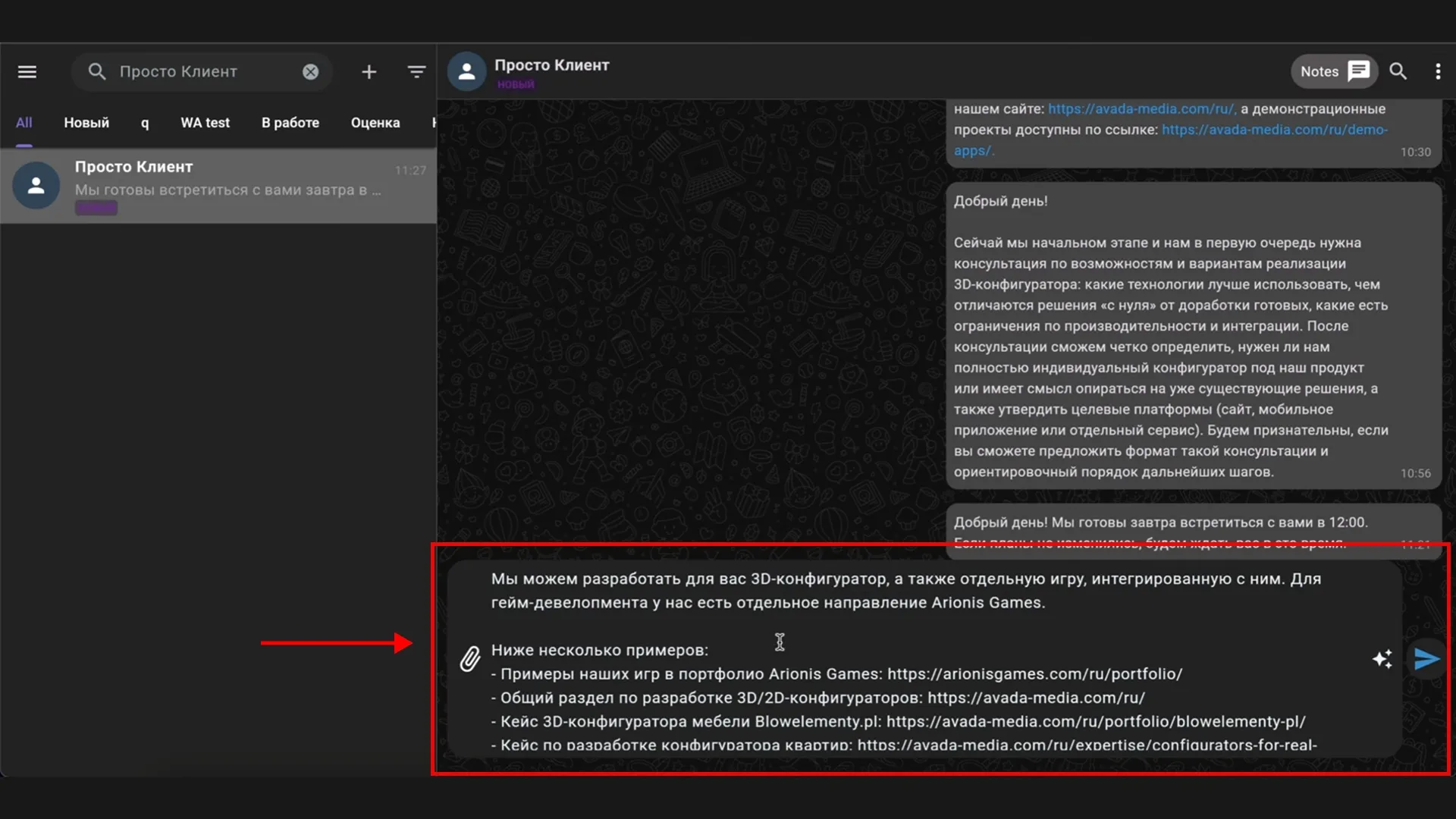
"Tell the client that we can develop a 3D configurator and game, and also include sample projects and links."
The AI agent analyzes the corporate knowledge base, finds relevant case studies, project links, game examples, and 3D configurator materials, and automatically generates a ready-made response for the client.
In fact, artificial intelligence begins to work as an internal AI employee who knows your company, your services and your materials.
How is this different from regular ChatGPT?
A typical AI without a corporate knowledge base can only generate generic text. It can write:
"We are ready to discuss the project and develop a solution."
But he doesn't know:
- what specific services do you provide;
- what projects have already been implemented;
- where are the cases located;
- what presentations are there;
- What technologies do you use?
- What prices and offers exist within the company.
An AI agent with a corporate knowledge base works completely differently.
He can:
- provide real links to cases;
- use your marketing materials;
- refer to specific projects;
- prepare more sales-oriented answers;
- formulate commercial proposals;
- use the company's accumulated experience;
- speed up the work of managers and the sales department.
In essence, this is no longer just text generation, but intelligent work with internal corporate data.
What does this look like in practice?
In one example, an AI agent was tasked with preparing a message for a client about the development of a 3D configurator and gaming platform.
While processing an AI request:
- accessed the internal knowledge base;
- found information about the GameDev direction;
- selected links to gaming projects;
- found cases using 3D configurators;
- I've put it all together in one concise message.
As a result, the manager did not have to manually:
- search for links;
- open websites;
- search for presentations;
- recall cases;
- copy materials.
The AI did all this automatically in a few seconds.

Where such AI agents are particularly useful
Such systems are particularly effective in companies with large volumes of information and complex services.
For example: IT companies, digital agencies, CRM and ERP developers, integrators, manufacturing companies, construction companies, SaaS platforms, e-commerce, companies with a large number of cases and presentations.
A particularly strong effect is achieved in the following departments: sales, customer support, pre-sale, marketing, account management, and preparation of commercial proposals.
What tasks can be automated?
An AI agent with a corporate knowledge base can help:
- respond to clients on Telegram, WhatsApp and email;
- prepare commercial proposals;
- collect briefs;
- find relevant cases;
- select presentations;
- search for the necessary documents;
- generate responses for the sales department;
- assist employees within the company;
- quickly train new managers.
Moreover, AI doesn’t just search for information, but helps to properly structure it and adapt it to a specific client.
Why is this especially relevant now?
Today, many companies have accumulated huge amounts of data that are not effectively used: old presentations, dozens of PDFs, case studies, documentation, internal instructions, knowledge bases, CRM data, and correspondence archives.
More often than not, employees simply don't have time to quickly find and use this information in their daily work.
AI agents enable this data to be transformed into a tangible, actionable tool that can help businesses on a daily basis:
- speeds up responses;
- reduces the workload on employees;
- improves the quality of communication;
- helps to prepare documents faster;
- makes the work of the sales department significantly more efficient.
Result
AI agents with a corporate knowledge base are no longer an experimental technology, but a practical tool for business.
Companies that have accumulated a large amount of internal data can use it to create their own AI assistant that:
- knows the company's products and services;
- knows how to find the necessary materials;
- assists managers;
- accelerates sales;
- improves communication with clients;
- automates routine work.
And most importantly, this AI starts working not on abstract data from the internet, but on the real experience and knowledge of your company.


