











 14
14
Online stores today operate in a highly competitive environment: customers are accustomed to instant responses, personalized recommendations, and convenient service — and if they don't get these, they simply switch to another retailer. Meanwhile, customer support teams struggle to cope with the volume of inquiries, marketers spend hours on product descriptions, and managers struggle to process requests manually.
This is where AI tools offer a significant advantage. They don't replace humans, but they do take on routine tasks — answering questions, generating content, analyzing conversations, and helping with product selection. This article highlights 10 specific tools that are already being used in e-commerce and delivering measurable results.
1. AI-powered abandoned cart detection and automated customer recovery
Cart abandonment is one of the biggest losses in e-commerce. According to the Baymard Institute, on average, 70% of shoppers leave without completing their order. Some were distracted, some hesitated, and some were simply comparing prices. Without automation, these people leave forever — manually chasing down every single one is impossible.
The AI system tracks the moment a customer adds an item to their cart and doesn't return, analyzes their behavior on the site, and launches a personalized return scenario. This could be a reminder email with photos of the exact items they viewed, a messenger message with a small bonus, or a pop-up offer when the user tries to close the tab. The key difference from standard triggered emails is that the AI takes into account the context: how many times the user visited the site, which products they viewed the longest, and at what stage of the checkout process they abandoned the cart. Recovering even 10-15% of abandoned carts provides a significant revenue boost for the store without increasing the advertising budget.

2. AI assistant for generating product descriptions
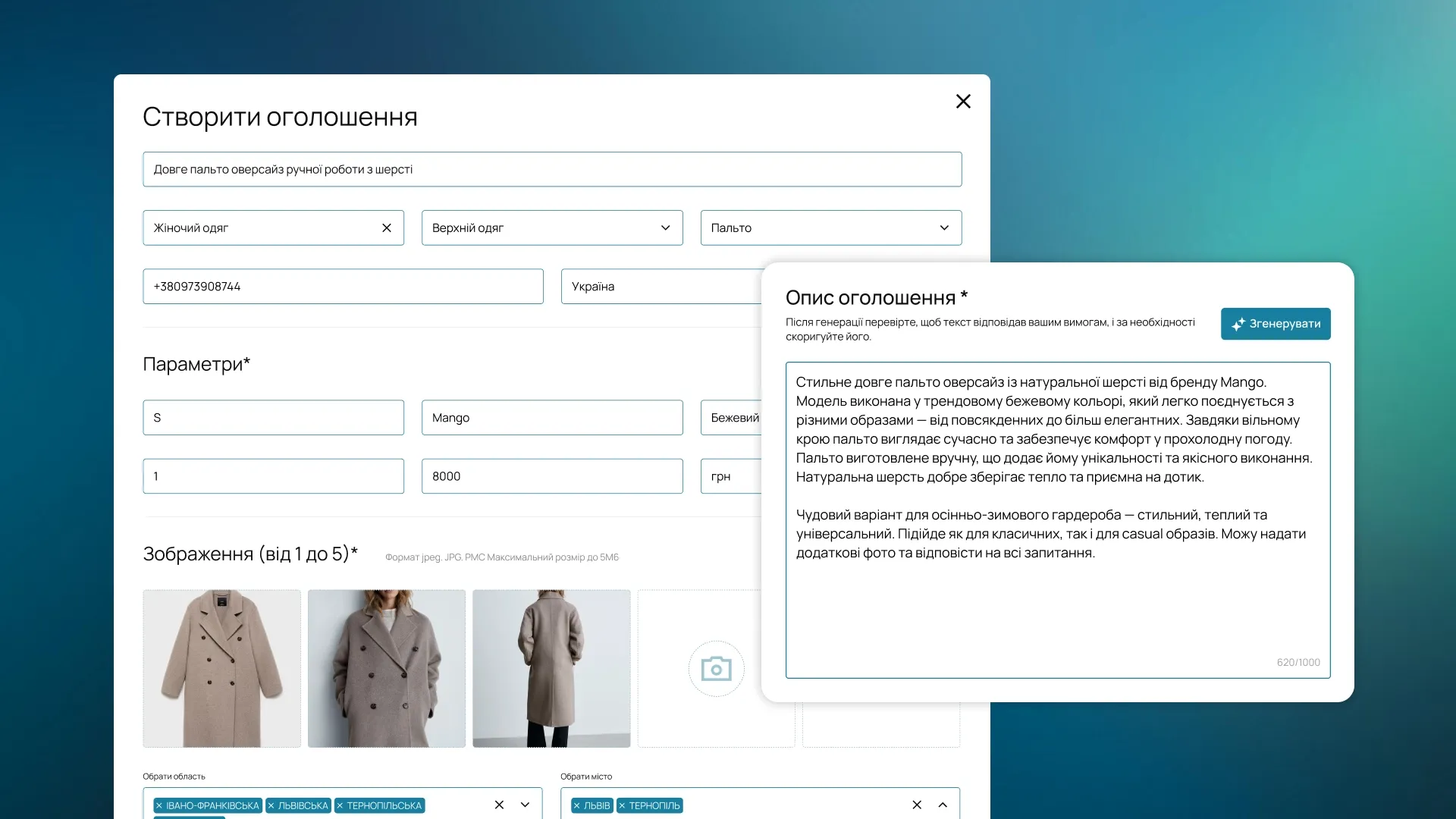
On classifieds platforms and in online stores, buyers make decisions in seconds. If a product description is too short, written dryly, or even copied from a supplier, the product listing simply gets lost among competitors. The problem is compounded by scale: manually writing strong, unique copy for thousands of listings is unrealistic.
An AI assistant is built right into the listing or product page creation form. Sellers enter basic information — name, category, condition, and specifications — and click a single button. The system analyzes this data and generates structured text with a product description, key benefits, and a call to action. If the result isn't satisfactory, you can request a different version or edit the suggested one. The assistant automatically adapts the style to the category: text for electronics will be technically accurate, for clothing — more emotional, and for furniture — emphasizing materials and sizes. Multilingual support is built in by default. As a result, descriptions become higher quality, more posts are posted, and the conversion rate from views to contacts increases.
3. AI consultant on the website - a virtual salesperson
In a brick-and-mortar store, there's a salesperson who approaches customers, asks what they're looking for, and helps them choose. In an online store, there's no such person, and many customers simply leave without understanding the selection.
An AI consultant is integrated into website pages and engages in a real dialogue with the visitor: it clarifies the task, asks about preferences, suggests suitable options, and explains the differences between products. Unlike filters and static FAQs, it understands context —for example, if a person is looking for a gift for a teenager with a budget of under $50, the consultant will suggest specific items rather than simply displaying a category. This directly impacts conversion rates and the average decision-making time.
Check out our case study: AI consultant for websites and brief generator.

4. AI assistant for 3D product configurator
Online stores that sell expensive, non-standard, or customizable products — custom furniture, kitchens, doors, windows, lighting, and appliances with multiple options—often use a configurator or construction kit, allowing customers to assemble the desired design themselves. This is a powerful tool, but it has a weakness: when a customer sees a technical 3D model of their own design, they can't imagine how it will look in reality. A digital object doesn't convey the atmosphere, doesn't show spatial proportions, and doesn't evoke that "yes, this is exactly what I want" feeling needed for an expensive purchase.
This is where the AI assistant changes the game. After the customer has completed the configuration, they click a single button and receive a photorealistic rendering of their finished product in their home. They can specify a style — Scandinavian, loft, classic — or upload a photo of their actual space, and the AI will integrate the assembled product directly into the space, with the correct proportions and lighting. The result looks like a professional interior photo shoot, not a technical drawing. This eliminates the main barrier to expensive custom purchases — the gap between what the customer has selected in the configurator and what they want to see in their home. Fewer uncertainties mean a shorter ordering process and fewer returns after receiving the product.
5. AI-powered catalog search with contextual understanding
Standard online searches rely on exact word matches — and that's their main problem. A customer types in "something warm for the dacha," "gift for dad under $100," or misspells a brand name — and gets empty or irrelevant results. If the customer doesn't find the product, the store loses the sale.
AI search understands the meaning of a search query, not just keywords. It considers context, synonyms, colloquial phrases, and even descriptive queries without the exact product name — finding exactly what the shopper had in mind. The system also learns the user's search behavior — what they've viewed previously, what filters they've applied — and refines the search results to suit the individual. As a result, shoppers find the desired product faster, are less likely to leave empty-handed, and the conversion rate from search to adding to cart increases significantly. For stores with a wide selection, this is one of the fastest ways to improve the user experience without changing the catalog.
6. AI analysis of calls and correspondence with clients
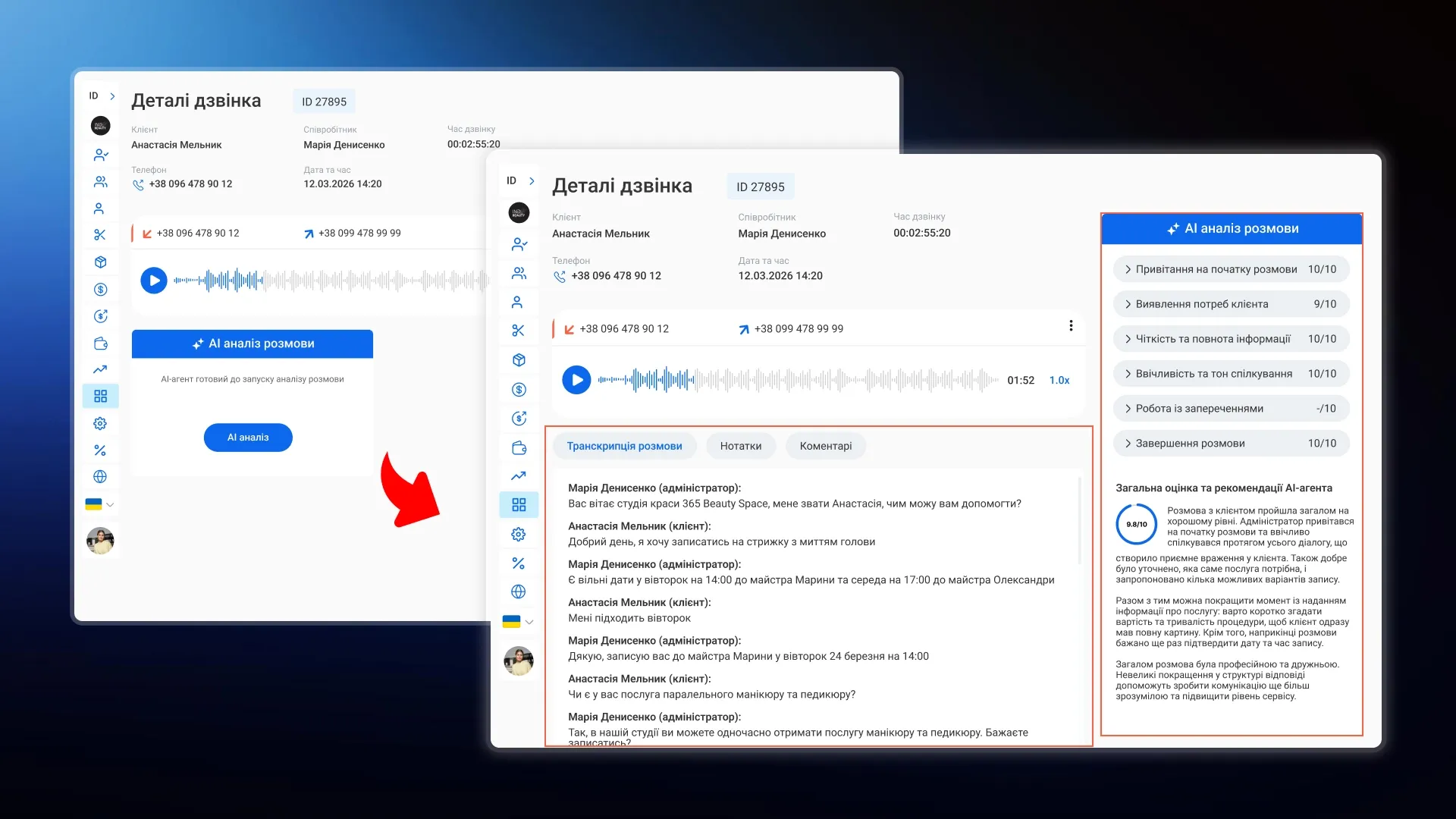
In e-commerce, where phone consultations impact sales — especially in niches with expensive or unique products — the quality of each call directly impacts revenue. If a sales representative fails to address an objection or offer an alternative, the customer switches to a competitor. Managers learn this at best from statistics, not from a specific conversation.
The AI agent is integrated into the CRM and automates the entire analysis cycle. After the call ends, the manager presses a single button – the agent converts the recording into text and evaluates the conversation based on preset parameters: identifying the need, presenting the product, handling objections, attempting to upsell, and closing. The output is a call summary, ratings for each criterion, the final status, and recommendations for the employee. The criteria are customized to the specific store's standards.
This tool is relevant not only for online stores, but also for any website where customer interaction directly impacts sales.
→ Find even more AI tools for websites in the article "TOP 10 Features That Speed Up Customer Service."
7. AI-based personalized recommendation system
Amazon has built a significant part of its success on a single phrase: "Frequently bought with..." Personalized recommendations aren't just a widget on a page. They're a mechanism that understands shoppers' intent and suggests things they haven't yet thought of themselves.
Modern AI recommendation systems operate fundamentally differently than simply "popular products" or "similar items." They analyze the behavior of individual users in real time — what they viewed, how long they spent on a page, what they added to their cart, and what they deleted and combine this with patterns from similar shoppers. The result is recommendations that truly meet customer needs. According to McKinsey, personalization can generate up to 15% additional revenue. For an online store with an established customer base, this is one of the fastest ways to increase the average order value and repeat purchase rate without incurring additional traffic costs.

8. AI tool for dynamic pricing
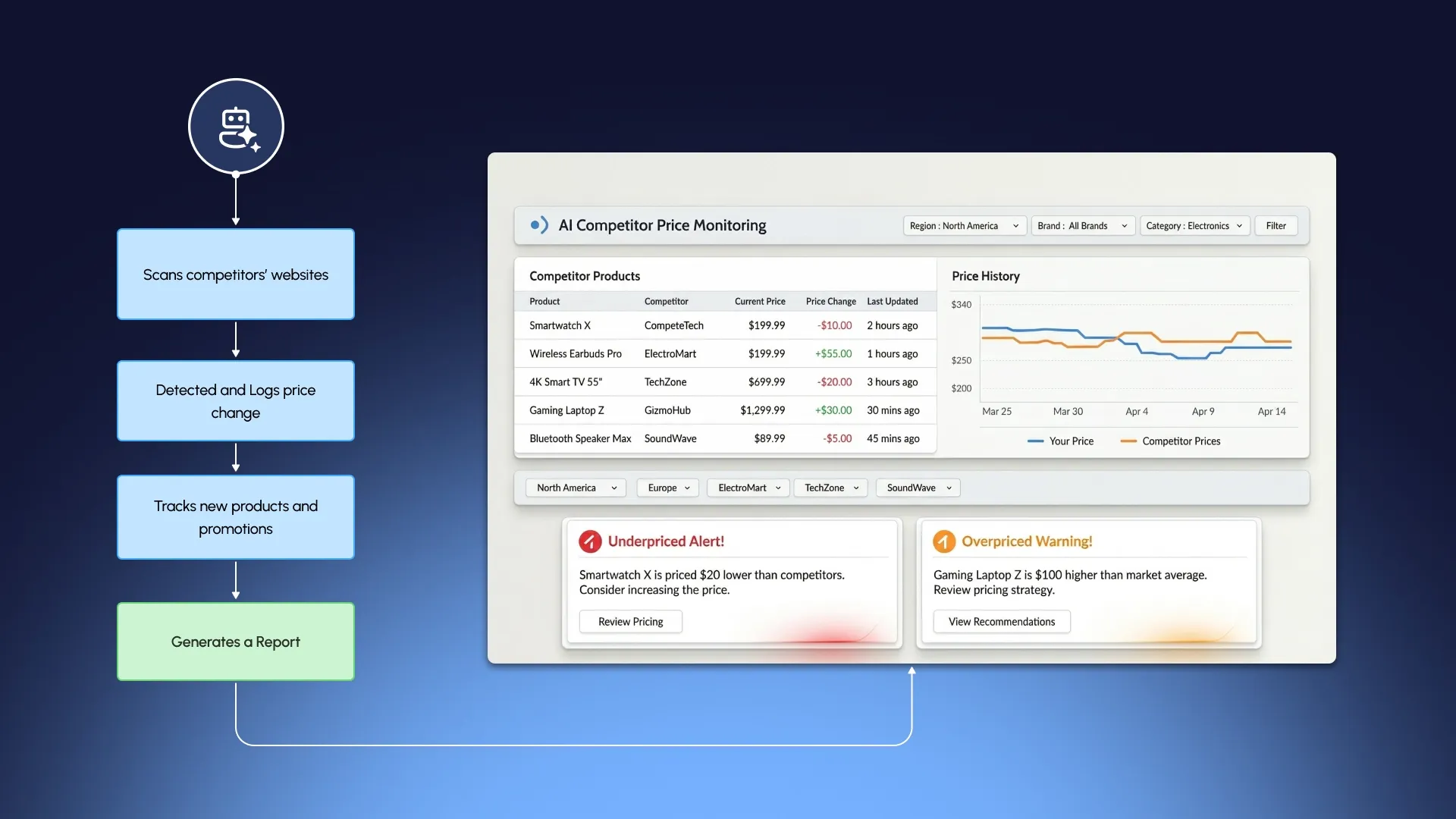
Maintaining prices manually when competitors change them several times a day is practically impossible. While your manager is monitoring competitors' prices in a spreadsheet, you're already losing sales or, conversely, leaving margins on the table.
The AI-based dynamic pricing system automatically monitors the market: it collects competitor prices, analyzes demand, takes into account inventory and sales history, and then adjusts your prices within specified limits — without human intervention. You set the rules: minimum margin, price corridor, and category priorities. The system operates within these boundaries, but makes decisions quickly and based on data, not instinct. This is especially relevant for stores in highly competitive niches—electronics, home appliances, and sporting goods — where price is often the deciding factor.
9. AI for demand forecasting and inventory management
"It's already gone" and "They overordered again" are two phrases that cost online stores money every month. Shortages mean lost sales and dissatisfied customers. Excess inventory means frozen working capital and storage costs.
AI demand forecasting models solve this problem more accurately than any spreadsheet or a buyer's intuition, because they simultaneously consider dozens of factors: sales history for each item, seasonality, holidays, current advertising campaigns, website traffic, and even external data like weather or the economic situation. The model detects patterns that a human simply can't detect manually. As a result, the store maintains an optimal inventory: the right products are available when needed, and funds aren't sitting idle. For businesses with a wide product range and seasonal fluctuations, this is a tool that directly impacts financial stability.

10. AI-based generation of visual content for product cards
High-quality visuals are one of the key conversion factors in an online store. However, a full photo shoot for each new item requires time, logistics, and money, which aren't always available. This is especially critical when the product range is large or collections are frequently updated.
AI tools for working with visual content solve this problem without the need for a studio or photographer. The input is a standard product photo against a neutral background. The output is a card with a professional background, a lifestyle image in the desired context (apartment, nature, office – depending on the product), and versions adapted for various formats: banners, squares for marketplaces, and verticals for social media. A separate feature is AI try-on for clothing and accessories, where the buyer sees the product on a model of the desired type. All this reduces the time-to-market for new items and reduces dependence on the content production cycle.

How to implement AI tools in an e-commerce project
There's no one-size-fits-all answer here the approach depends on what stage your project is at and what tasks are your top priorities.
The optimal option is to integrate AI functionality into the website development process. When the architecture is built from scratch, it is designed for integration with the required models and APIs, without the compromises, workarounds, and limitations imposed by ready-made platforms. Custom development gives you complete control over the logic of your tools, the data they use, and how they interact with each other. This is important because AI tools perform significantly better when they have access to real data from your business — order history, customer database, CRM, and inventory levels.
If the website already exists, many of the tools on this list can be added as separate modules — a chatbot, an AI consultant, a description generator — without redesigning the entire project. This is feasible, but requires a technical assessment: how capable the current stack is and what integrations will be required.
CortexIntellect specializes in developing AI solutions for businesses and works with projects of all sizes, from the targeted implementation of a single tool to building a full-fledged AI infrastructure from scratch. Our portfolio includes real-world use cases for e-commerce, CRM systems, classifieds platforms, and product configuration tools. We understand the internal workings of these tasks and offer solutions that work in production, not just in demo form.
Contact us for a consultation – we'll analyze your project objectives and offer the optimal implementation path.
We've compiled more AI tools that speed up customer service on any website — not just online stores — in a separate article: [TOP 10 AI Features for Your Website That Will Speed Up Customer Service].

